 STANTON
ANALYTICA
Know what's working. Do more of it.
Terminal studies your own trades and shows you, in plain dollars, which setups pay you and where you can get better.
Private beta: request access and we will email you an invite. Your book follows you to every device you sign in on, end-to-end encrypted when you set a passphrase.
Do more of what works.
Every trade is sorted into what helps you and what holds you back. Most traders are surprised by at least one line. Each comes with a dollar figure, so you know where to focus next.
- LEAKRule breaks cost you · 69 trades−$97,006
- EDGE“Trend continuation” is your best edge · 46 trades+$42,584
- EDGESetup “Reversal” pays · 51 trades+$24,666
- LEAK“FOMO entry” is your costliest habit · 7 trades−$19,448
- LEAKWhen you hesitate, results suffer · 6 trades−$18,347
- EDGEYour “swing” trades are a real edge · 49 trades+$15,918
- LEAKSetup “Range fade” loses money · 37 trades−$15,689
These results are based on simulated or hypothetical performance results that have certain inherent limitations. Unlike the results shown in an actual performance record, these results do not represent actual trading. Also, because these trades have not actually been executed, these results may have under-or over-compensated for the impact, if any, of certain market factors, such as lack of liquidity. Simulated or hypothetical trading programs in general are also subject to the fact that they are designed with the benefit of hindsight. No representation is being made that any account will or is likely to achieve profits or losses similar to these being shown.
Every trade you take is a lesson. Terminal makes sure you keep it.
Find what pays.
Every setup, ranked by the dollars it actually made you. Not how it felt.
Find what's costing you.
The early entries. The losers held too long. Shown plainly, with a dollar figure, so you can change them.
See the rough patch coming.
Your own record, run forward, so a bad stretch never takes you by surprise.
What could one better habit be worth?
Move the sliders to match your trading. Small fixes add up faster than most traders expect.
That's what fixing one habit can be worth. Terminal shows you which one.
An illustration of your own inputs, not a promise of results. Worked out in this page; nothing you move here is sent anywhere.
Twelve answers about your own trading.
Every one of them runs on your own trades, the moment they're in.
Your edge
Which plays pay you, in dollars.
Your leaks
The habit that costs you, priced.
The drawdown ahead
The bad stretch, before it comes.
Every market, one screen
Stocks to crypto, side by side.
Options, without the guesswork
What it can make and lose, before you send.
The news that moves your names
Only what moves what you hold.
The company behind the ticker
Filings, insiders, numbers. One keystroke.
Strategies that come back graded
A straight answer before real money.
A risk desk that has your back
Your limits, held when you don't.
A journal that remembers
Every trade and why you took it.
Any currency, any venue
Anywhere you trade, one book.
Private by design
Encrypted end to end when you set a passphrase.
One seat instead of a stack of subscriptions.
Your broker holds the money. Terminal holds the edge. Most traders pay for four or five tools that watch the market and never talk to each other. In Terminal every part reads the same book, so it can watch the trader too.
| What you need | In Terminal | The usual way |
|---|---|---|
| Charts for every market | Included | A charting app |
| A trade journal | Included | A journal app or a notebook |
| Portfolio tracking across accounts | Included | A spreadsheet |
| Analytics on your own trades | Included | Usually nothing |
| Risk limits held for you | Included | Willpower |
| Strategy testing, graded | Included | A separate backtester |
| News, filings and research | Included | A news service |
| Paper trading under your real rules | Included | A broker demo |
Everything a serious trader needs. One seat.
Charting, a trade journal, portfolio tracking, risk tools, news and research, in one window and built around your own trades.
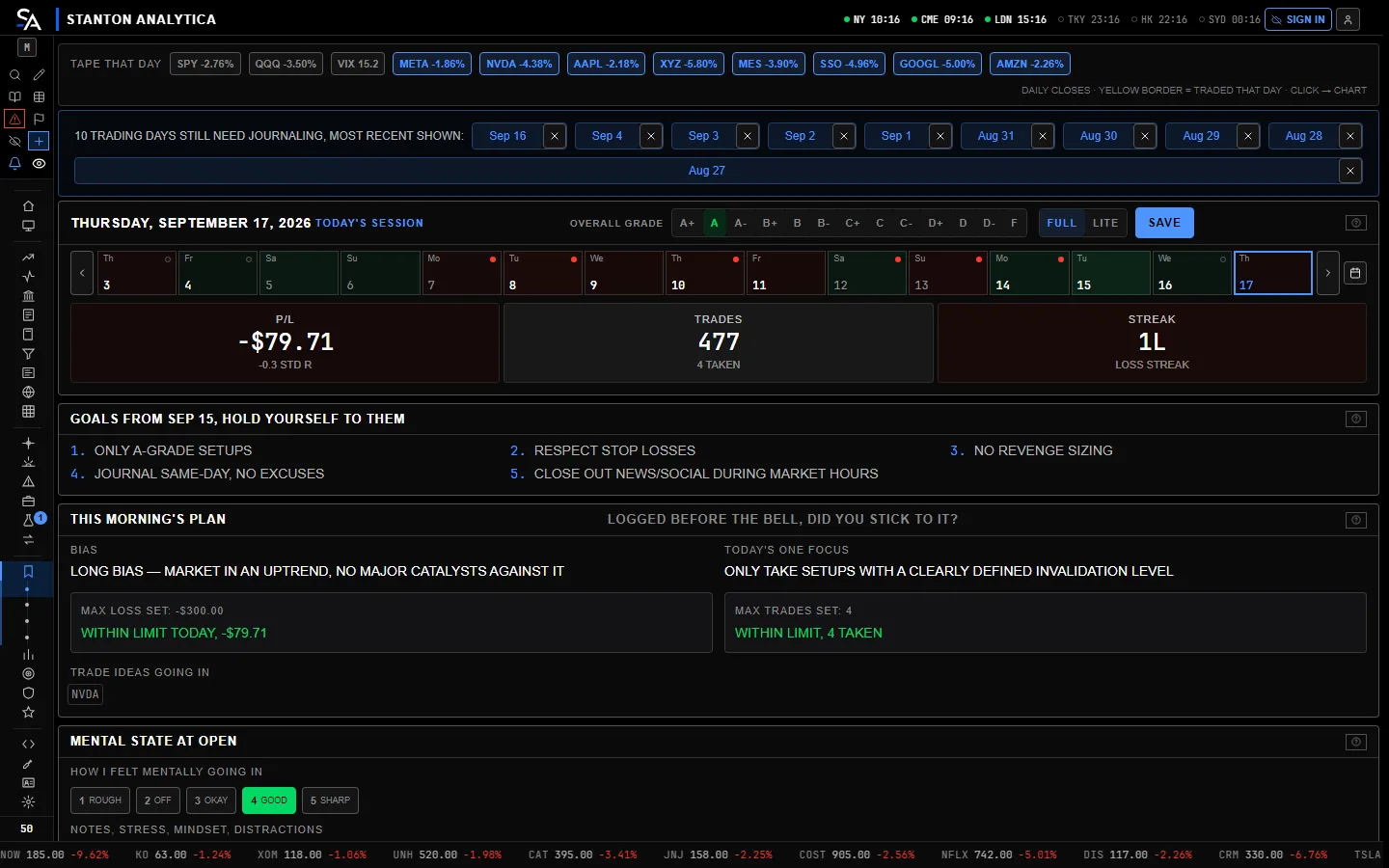
Your trading diary, kept for you.
Load a statement and every trade is in. Add why you took it, a screenshot and how you felt, then review the day in minutes.
- Every trade in, tagged and searchable
- Daily review, goals and notes
- Tax-ready at year end
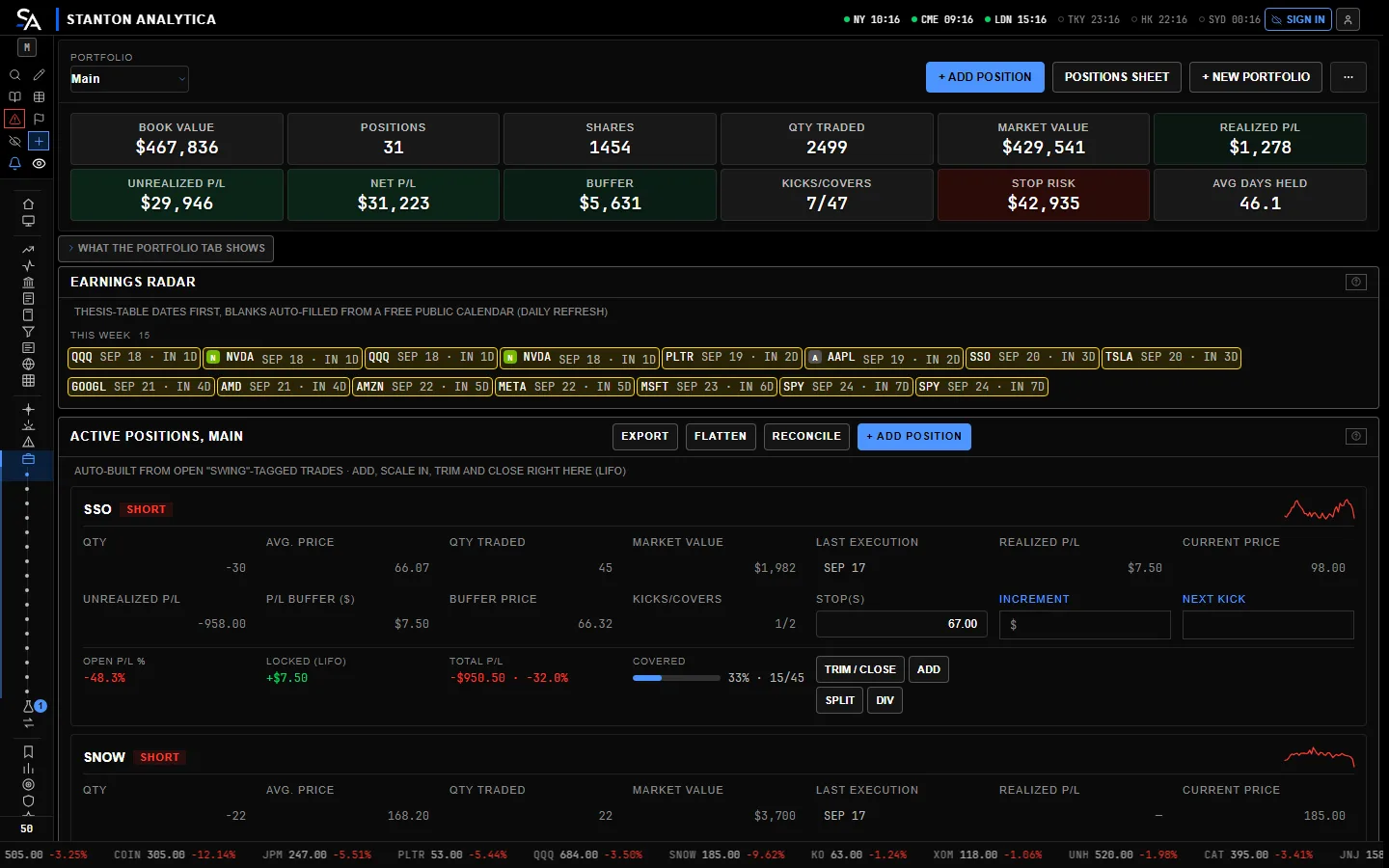
Every position, always current.
Stocks, options, futures and crypto in one book, in your own currency, with the profit and loss on each.
- One row per option contract
- Every account in one view
- Open risk at a glance
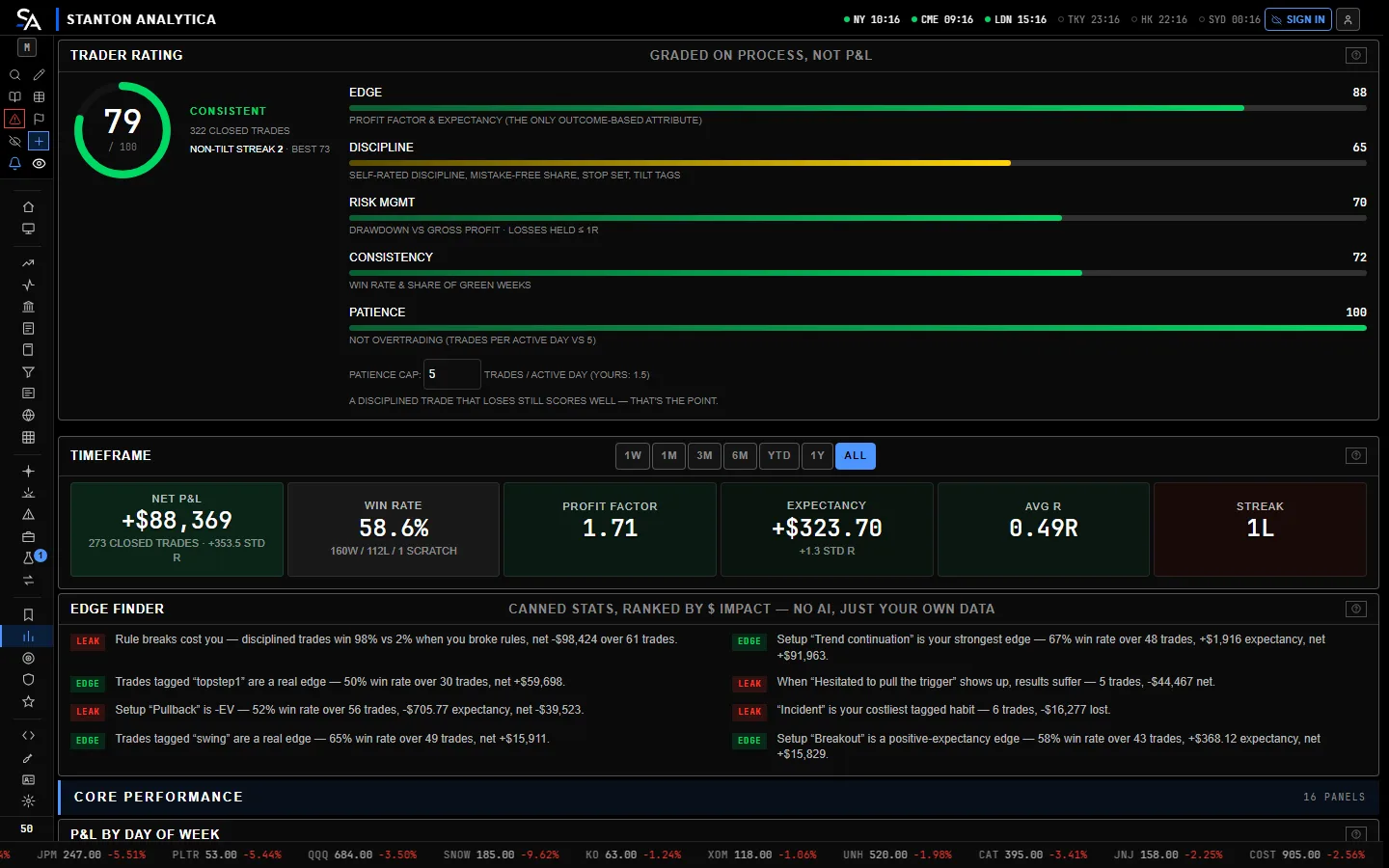
Your numbers, finally explained.
A trader rating, the Edge Finder, and your results by setup, hour and day, so you can see exactly what works for you.
- Trader rating, graded on process
- The Edge Finder, ranked in dollars
- Results by setup, hour and day
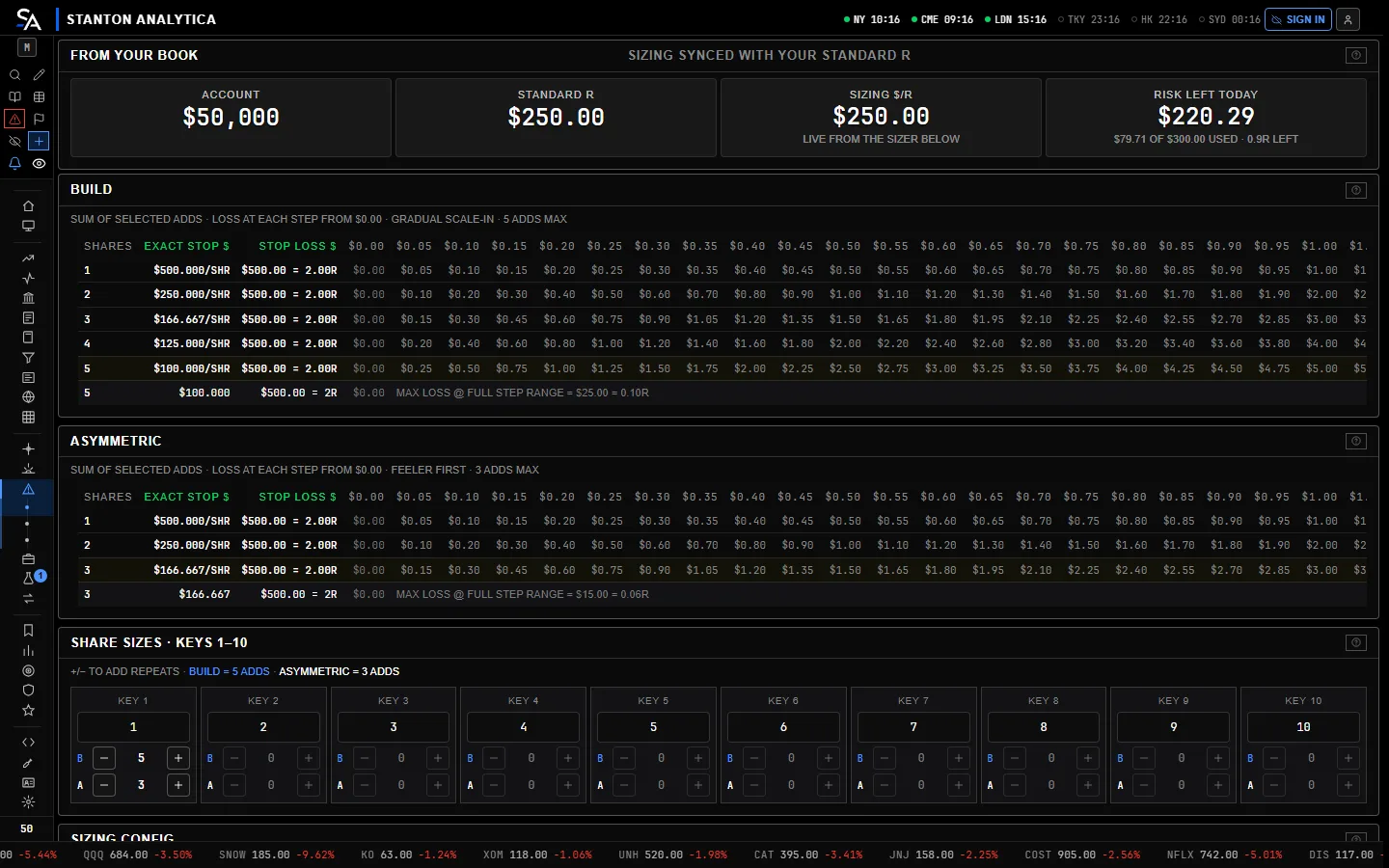
Stay in the game.
Your loss limits held for you, the bad stretch seen in advance, and the right size worked out before you click.
- Daily loss limits you set
- Position sizing
- Drawdown and stress tests on your own record
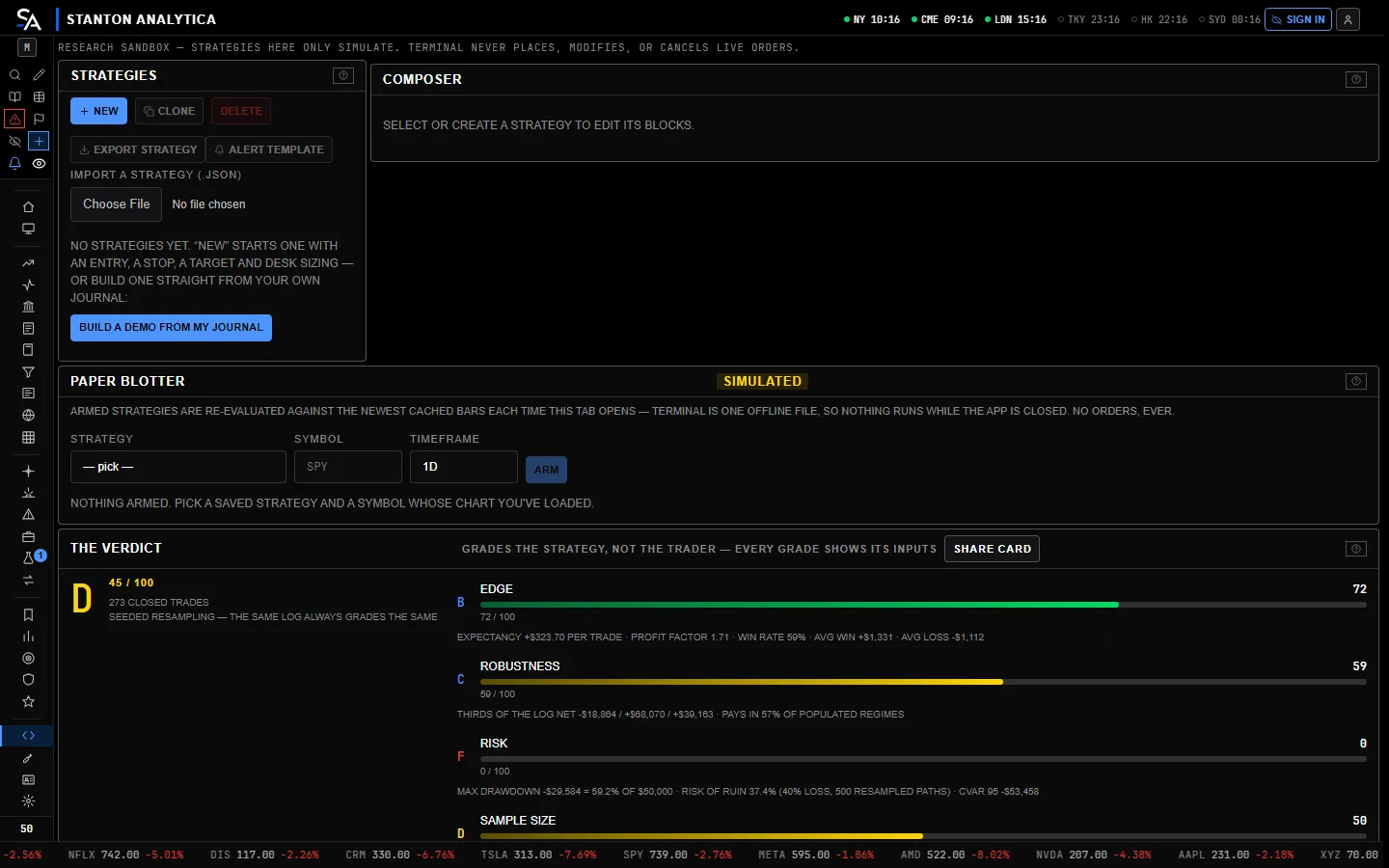
Your whole desk on one screen.
Type a ticker and a code and the window opens. Charts, quotes, news and your book side by side, arranged the way you trade.
- Open anything by typing its code
- Windows you arrange and keep
- Keyboard first
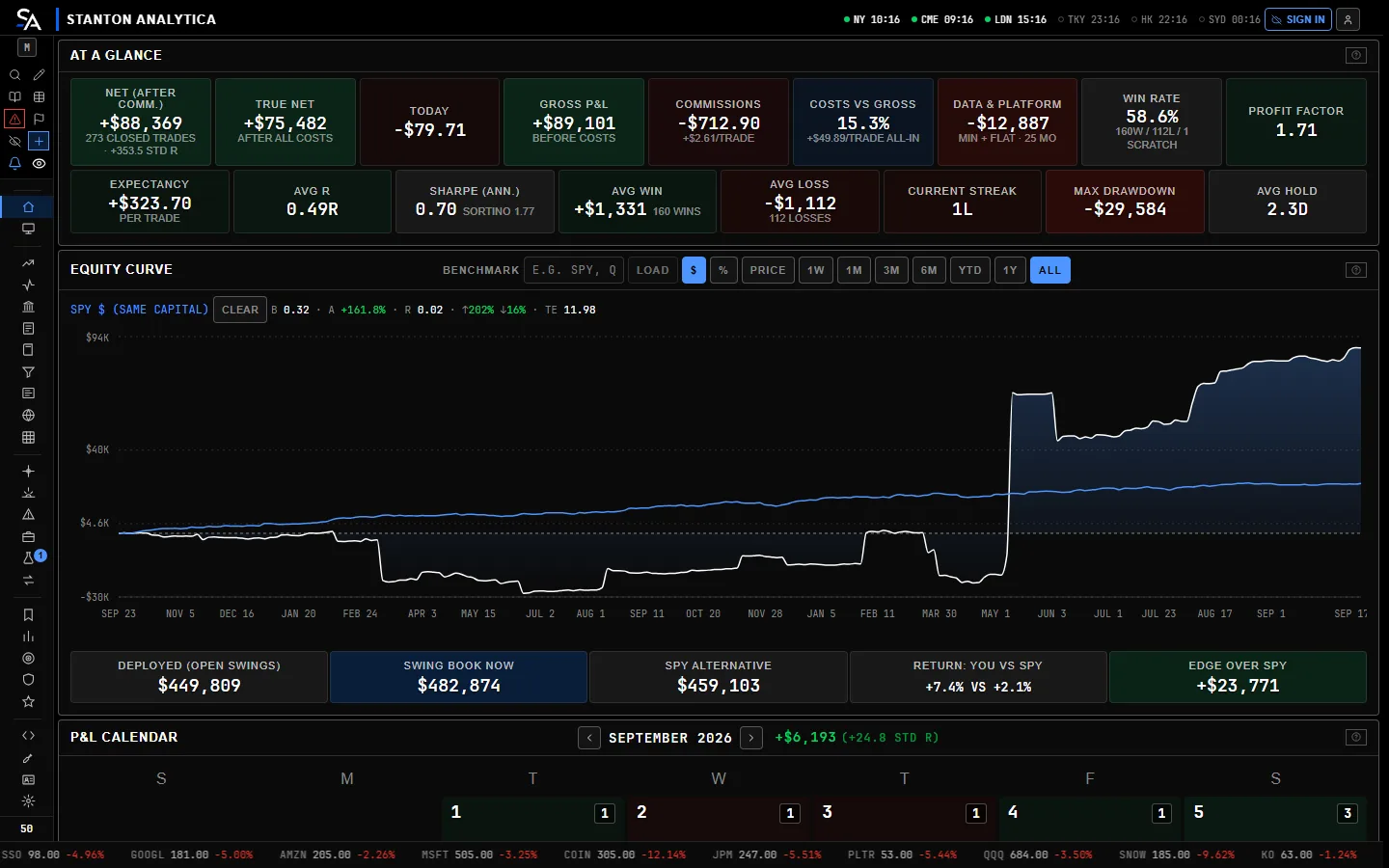
Test it before you trust it.
Build a strategy from blocks, run it on history, and get a plain grade on whether it holds up.
- Backtests graded A to F
- Stress tests that look for luck
- No code needed
Every market, live.
Charts for stocks, options, futures, bonds, currencies, crypto and event markets.
The news and the filings.
Headlines, company filings, insider moves, calendars and screeners, a keystroke away.
Practice with no risk.
Trade the live market with practice money, under the same rules you set for real.
Your broker, connected. Your journal, live. In approval
When your broker approves the connection, your fills arrive the moment they happen. No statement to load, no trade to type. Connections to 35 brokers are built and waiting on each broker's approval. Not available yet.
Open the real app. No sign-up.
A sample trader's book is already loaded. Click around the dashboard, the journal, the analytics and the risk desk, exactly as it runs once you're in.
Open the sample book →
Opens in a new tab. Nothing you click there is saved to an account.
From a statement to answers.
On the left, what your broker gives you: rows of fills. On the right, the same trades in Terminal, with the result, the grade and the setup on every one.
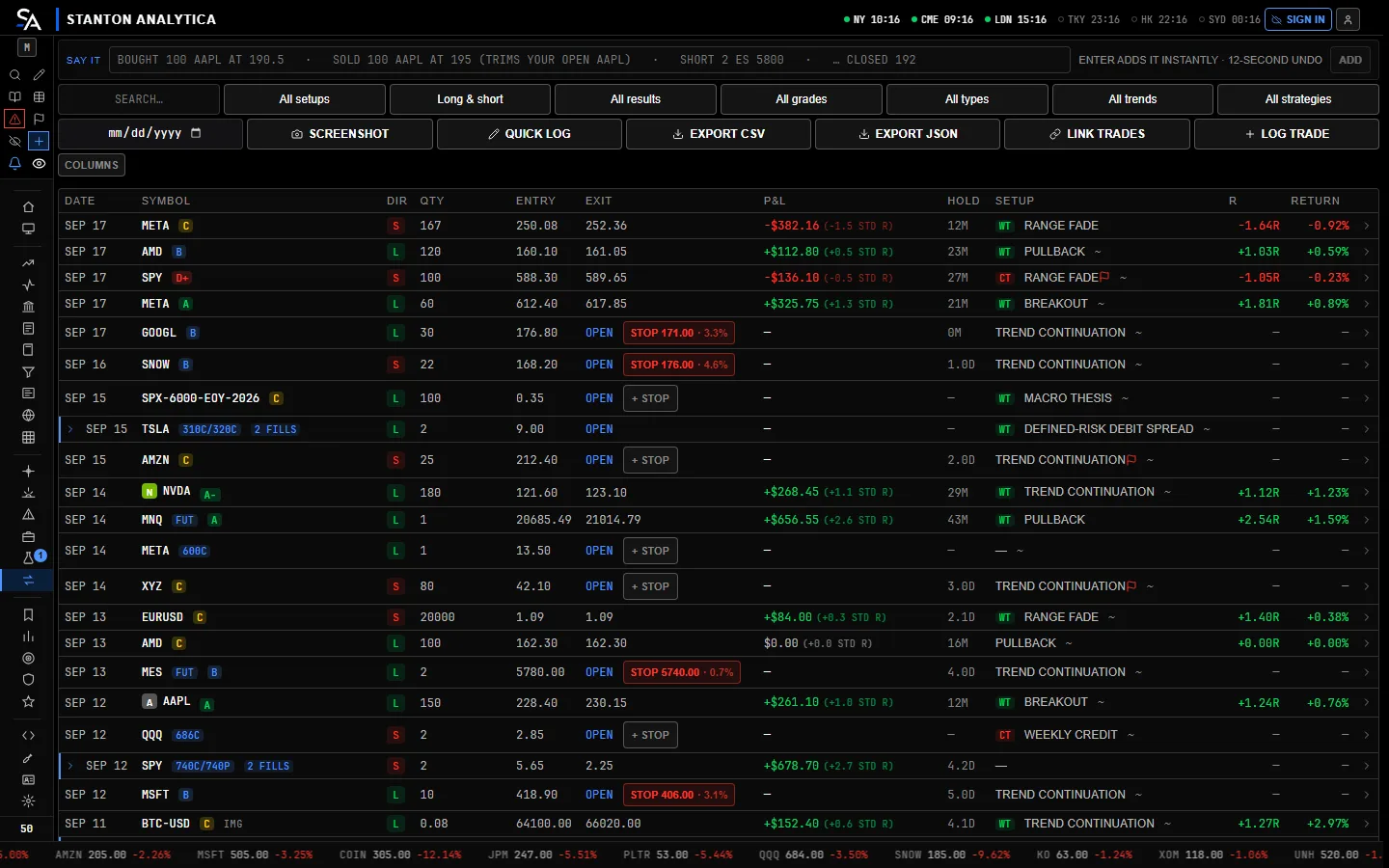
Drag across to compare. The fills on the left are the sample book's, the way a broker prints them.
Whatever you trade, it fits how you trade.
Terminal reads stocks, options, futures, currencies and crypto, and every view works on your own record.
Day traders
See which hours and setups pay you, and keep a daily loss limit that holds.
Swing traders
Every position in one place, and how long your winners and losers really last.
Options traders
One row per contract, spreads kept as one trade, and the payoff before you send it.
Futures traders
The right contract sizes, and the year-end tax treatment handled for you.
Funded-account traders
Run your own record through a funded challenge's rules before you pay for one.
Up and running in three steps.
No install and no card. Most traders see their first answers the same day.
Request access
Leave your email. Invites go out in small groups, and your invite email finishes setup. Add a passphrase and your book is encrypted end to end.
Load your trades
Paste or upload your broker's statement. Stocks, options, futures and forex all come in.
See what's working
Your trader rating, your best setups and what to fix next, in plain dollars.
At your desk, or in your pocket.
Terminal runs in your browser on any computer, and adds to your phone's home screen like an app. Your book follows you when you sign in.
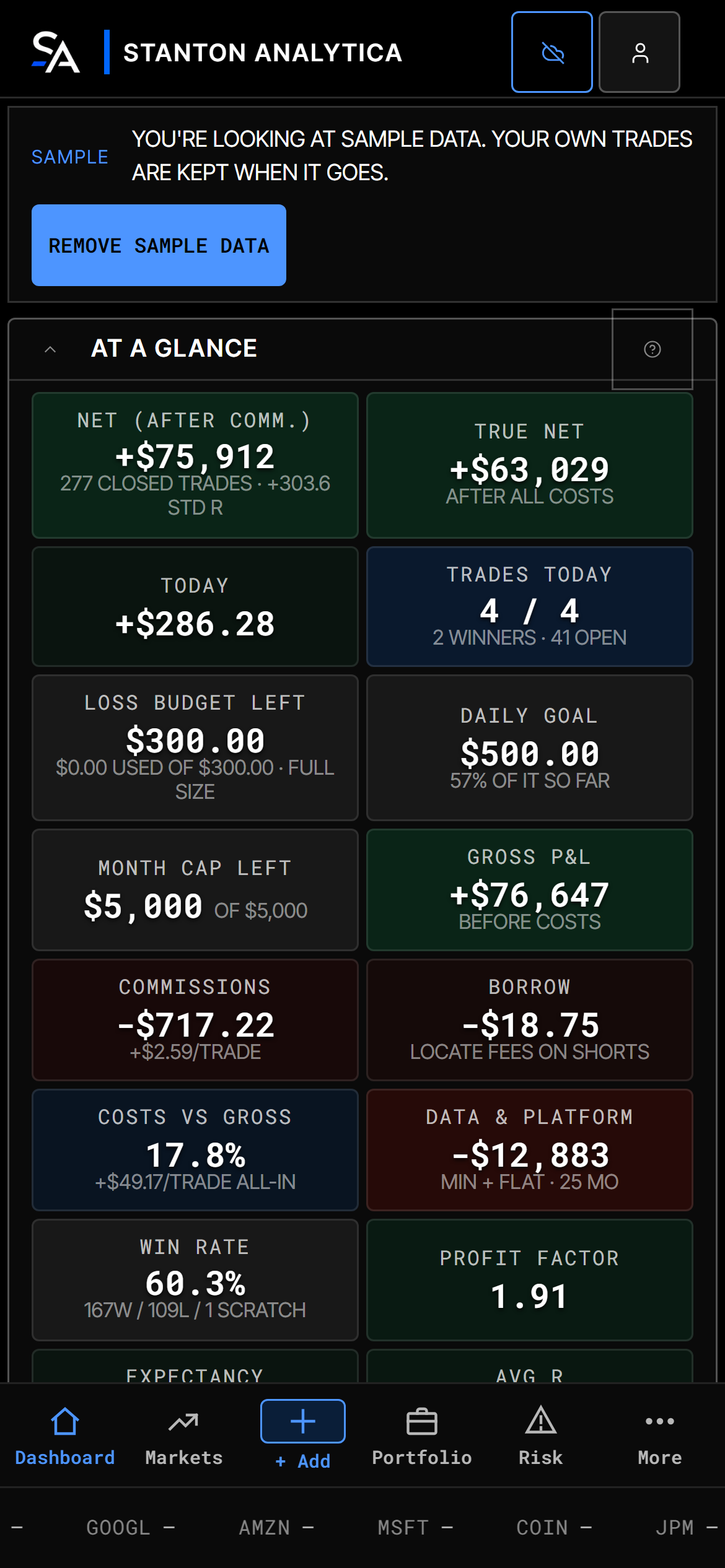
And the whole trading desk around it.
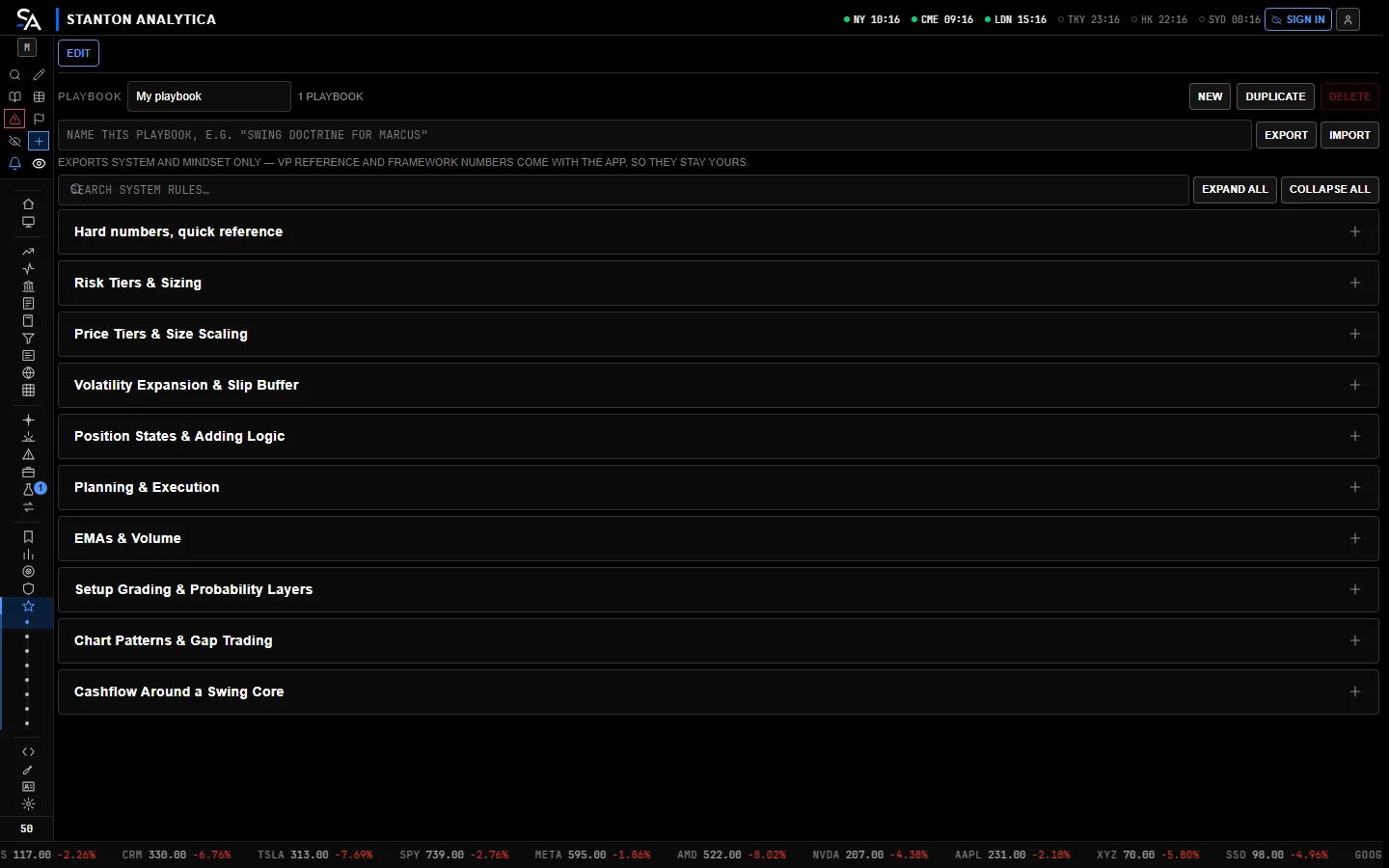
The analysis is why you come. The rest is why you stay. Every picture below is a screenshot of Terminal, captured by script from the sample book that ships with it. Click one to open it full size.
Know the trade before you place it
Build any position and see exactly what it can make and lose. It lands in your book the way you think of it.
One volatility score, and everything agrees with it
How loud this bar is against the same time of day over fifteen sessions, as a score from −5 to +5 and the position-size multiplier it maps to. The two ThinkorSwim studies ship with the app, and Terminal runs the same engine: the number on your chart and the number sizing your trade are the same number. Every trade records the score it was taken on, so the journal can finally answer whether sizing down at +4 actually helped.
Ships with Vol Profile, the volatility score and the stops that read it. Keep your own scripts too, and share them by link once you sign in.
Your trades are yours.
Four rules the product is built on. They are why it costs what it costs, and why it is worth it.
- 01We grade process, not luck.
- 02Encrypted end to end when you set a passphrase. Without one, we tell you.
- 03Export everything, any time. Leaving costs you nothing.
- 04One seat does the whole job.
How your account is kept safe
- 01Your book travels encrypted and is kept under your account. No other account can read it.
- 02Want it private even from us? Set a passphrase and your book is encrypted end to end, in your browser, before it leaves.
- 03Two-factor sign-in with an authenticator app.
- 04Our servers turn away suspicious requests and watch for break-in attempts.
Built by a trader, for traders.
I'm Tate, and I've been trading Wall Street since the day I was old enough to open an account. One thing I've learned: you can't improve what you can't see.
Most traders run their business blind.
I built Stanton for my own trading first. Now it's yours.
Stop guessing. Start proving.
— Tate Olsen
One desk. Free while it's in beta.
Trader for the journal and analytics, Pro for the full terminal with advanced analytics and risk tools, Desk for the professional workflow. By the month, or by the year with two months free. Every plan is free during the beta.
Everything in Desk, free while Terminal is in beta.
- Everything in Desk
- No card, nothing to cancel
- Your feedback shapes what ships next
Core terminal, journaling and analytics.
- Unlimited trade journal
- Trade tagging
- Performance analytics
- Session reviews
- P&L and statistics
- Rules and playbook tracking
- Dashboards
The full terminal, with advanced analytics and risk tools.
- Everything in Trader
- Advanced performance analytics
- Risk management
- Advanced charts and visualizations
- Advanced journal analytics
- Custom reports
- More powerful filtering
- Live market and terminal features
Everything, plus the professional workflow.
- Everything in Pro
- Multiple accounts
- Advanced market tools
- Advanced alerts
- API and export
- Professional workflow features
- Priority support
Paid plans open after the beta. Everything above is free to every beta account today, and nothing takes a card.
Prices in USD. Cancel whenever you like once they open; you can export your book any time, so leaving costs nothing.
Got an invite or promo code? Enter the code when you finish setting up from your invite email.
Before you request access.
My broker already gives me reports.
Reports tell you what happened. Terminal tells you why, and what it cost you.
I already journal in a spreadsheet.
A spreadsheet only holds what you type into it. It never tells you anything back.
I don't trade enough for this.
Ten trades are enough to spot a habit. Fifty are enough to put a price on it.
I'm already profitable.
Then find the setup that pays you most, and size into it. Profitable traders have leaks too.
Does it work with my broker?
If your broker can export your trades or let you copy them, yes. Stocks, options, futures and forex.
Where is my data?
Under your account. Your book follows you to every device you sign in on, encrypted end to end when you set a passphrase.
Can I leave?
Any time. Export your whole book from the Accounts tab and take it with you.
Make your next hundred trades your best hundred.
Request access
Terminal is in private beta. Leave your email and we will send you an invite as seats open.
You're on the list
Thanks. We saved your request for your address.
- We review requests. Terminal is in private beta, so access is by invite.
- Invites go out in small groups. Each group helps shape what ships next.
- Your email has a link to finish setting up. Choose a username and a password, and you're in.
No spam. One email when your invite is ready.
Try Terminal with sample data while you wait Back to the home pageCheck your email
Thanks — your account is created. We sent a confirmation link to your address.
- Open the link in that email. It confirms the address and opens Terminal signed in.
- Nothing there after a few minutes? Check spam or promotions, then sign in — an unconfirmed address is told so.
- Your promo code is kept, and applied the first time Terminal opens signed in.
Privacy
The short version. Terminal runs in your browser. When you sign in, your trades, journal and settings are synced to our server under your account, so your book follows you to every device you sign in on. That copy is end-to-end encrypted when you set a passphrase, and stored in plain text without one. There is no analytics, no tracking and no telemetry of any kind, and we take no payments yet.
What is stored, and where
Terminal is a single page that runs in your browser. Everything you enter — trades, positions, journal entries, session reviews, goals, risk caps, settings and layout — is written to your browser's IndexedDB storage on the device you are using while you work and, once you sign in, synced to your account (see Cloud sync below). It stays until you delete it.
Seconds and tick charts are built from the market trades the app hears while it is open. Those trades are kept in a separate IndexedDB store on your device for five days, so the chart has history; they are market data, not anything you entered, and they are never uploaded.
Without an account we hold nothing about you beyond an email you leave with us (below). During the private beta an account starts from an invite; sign-in is handled by Supabase Auth on our project: we hold your email address, the username you pick (a display name, which you can change on the Accounts tab), a salted password hash and the date of the terms you accepted, and nothing else — no real name, no card. Sign-in scopes your synced copy to you.
If you leave your email for launch notes, or to request access during the private beta, we keep that address, which of the two you asked for, and the day you left it, in a table only we can read, only to send launch notes or your invite. Nothing else is kept with it and it is never shared; write to us (Contact) and we take it off.
What leaves your device
Only the things listed here can, and each is either explicit or narrow. Several of them exist only if you switch them on, and the ones at the end of the list are doors you have to open yourself — a Terminal nobody configures talks to market-data sources and nothing else. This list is meant to be complete: if you find a request it does not cover, that is a bug in this page and we want to hear about it.
-
Market data requests. To draw a chart or price a position,
the app fetches from public third-party sources (for example Yahoo Finance,
Stooq, the SEC, FRED and, if you supply keys, Finnhub or marketdata.app).
Those requests carry a ticker symbol and a date range — never
your positions, sizes, P&L or journal. (True of market-data requests. The
AI-assist flow below is the exception, which is why it is spelled out
separately rather than folded in here.)
Market data is always on — there is no switch to turn it off. The
requests carry a ticker symbol, not your book. Some are routed through public CORS
proxies, which see the same ticker-level request. Option chains are
routed through a relay (
/api/chain): it sees the same ticker-level request and forwards it upstream. On our hosted site that relay is our server, not a third party’s and not yours — so we see the ticker and the date range, the same as any other market-data request on this list. If you run your own copy of Terminal it is your server instead. - Cloud sync — on when you sign in. Once you are signed in on our site, your book is mirrored to our database (a Supabase Postgres project) under your account, so a new device can restore it. If you set a passphrase it is end-to-end encrypted in your browser first (PBKDF2-SHA256 → AES-256-GCM), and the server stores a single opaque blob it cannot read. The passphrase is held in your browser's memory for the session only — never written to your device, never sent anywhere — so you enter it once per session. Without a passphrase the copy is stored in plain text on our server — so set one. Screenshots never leave your device either way.
- The AI Coach — off unless you set it up, and it DOES send a summary of your journal. This is the one outbound flow that carries your own trading data, so it is described in full. The Coach runs on a model you host, in Ollama or LM Studio. When you ask it for a report or a question, the app builds a journal digest — a summary derived from your trades, including what you hold now — and sends it, with your question and, where you attach one, a chart screenshot, to the address you configured. That address is on your own machine by default, and then nothing leaves it; if you point it at another computer, the digest goes there. Terminal holds no AI key and connects to no hosted AI service (the optional Anthropic key and the screenshot importer were removed on 25 September 2026). Stanton AI's other answers and Ask the Journal use no model at all: they are worked out in your browser from your own data. No Coach request is ever made unless you have set up a runner and asked. The digest is assembled in your browser at the moment you ask; it is not stored or sent anywhere else.
- Optional integrations you enable. Web Push alerts only operate after you switch them on. Push stores a browser-issued subscription token and the price levels you set, so a scheduled job can notify you; it never receives your trades.
- A security watch at our server's doors. When our server turns a request away (a sign-in that does not check out, a request that is not allowed, too many requests from one place), it keeps a short record so the owner can spot someone trying to break in: the time, which part of the server, the country your connection reports, the account id the request claimed, and a scrambled tag made from your address that cannot be turned back into it. It never records your address itself, your email, a password, a sign-in token or anything in your journal. The records are deleted after 30 days, and only the owner can see them.
-
Doors you open yourself, and what each one sees. These are off until
you use them, and every one of them is listed here because it leaves the device:
- Live quotes through our keys (
/api/keys,/api/relay,/api/stream) — when you use our market-data keys rather than your own, the request goes through our server, which sees the ticker and the date range./api/keysanswers only whether a key exists, never its value. - The TradingView chart panel (
/api/tv) — loads a third-party widget, which sees the symbol you are looking at. - A promo code (
/api/promo) — the code and your account id, so it can be redeemed once. - An incoming webhook (
/api/hook) — a URL you create so an outside tool, such as a TradingView alert, can post a trade line to your book. Anything sent to it passes through our server on its way to you. - Phone as remote (
/api/remote) — pairs a phone to a desk session so it can drive it; the pairing and the commands pass through our server.
- Live quotes through our keys (
API keys you paste in
Keys for market-data providers are kept in your browser's local storage and are sent only to the provider they belong to. They are never routed through a proxy or relay, and never to us. They are never written into a backup export, encrypted or not — a backup carries your book, not your credentials.
Cookies and tracking
Terminal sets no cookies and includes no analytics, advertising, fingerprinting or session-replay code. Nothing counts your visits. The app uses browser storage purely to hold your own data and your sign-in in your browser. One exception, only when you sign in or create an account: the sign-in form may run a Cloudflare Turnstile check (a bot check, usually invisible), which means Cloudflare sees that request. Nothing else on the site loads a third-party script.
Exporting and deleting
- Export: Accounts → Backup & Restore writes a JSON file of everything. An encrypted export (AES-256-GCM, passphrase-derived) is also available.
- Delete: clearing this site's browser data removes your book from that device. If you have an account, sign out and write to the contact below and we will delete your synced copy and your account.
Please keep your own backups. With a passphrase set we cannot read your synced copy, so we cannot recover a book whose passphrase is lost.
Children
Terminal is a tool for adults managing their own trading records and is not directed at children.
Changes
If this policy changes, the date at the top changes with it. Material changes to what leaves your browser will be called out in the app.
Contact
Questions or a security report: tate@stantonanalytica.com. Security contact details are also published at /.well-known/security.txt.
Terms of service
The short version. Terminal is analysis software for your own trading records. Nothing here takes payment today. Terminal is in beta, every feature is free to every beta account, and there is nowhere to enter a card. Paid plans are described below as what they will be, and section 4 says which of those terms only start to apply on the day they open. It is a tool, not advice: every number it shows is computed from what you entered and what public sources answered, and it can be wrong. Your data stays yours.
1. Who these terms are between
These terms are an agreement between you and Stanton Analytica ("we", "us"), the maker of Terminal ("Terminal", "the service"). By creating an account, paying for a plan, or using Terminal, you agree to them. If you do not agree, do not use the service.
You must be at least 18 years old, or the age of majority where you live, to create an account or buy a plan.
2. What the service is
Terminal is a browser application: a trading journal, analytics, a risk engine, charts, options tools, research panels and a command-line desk. It runs in your browser. When you sign in, it syncs your records to our servers under your account so they follow you to every device you sign in on (end-to-end encrypted when you set a passphrase), and it relays market data and push notifications on your behalf.
Terminal does not connect to a brokerage, hold funds, place or execute orders, or move money. Nothing you do in it buys or sells anything.
Built with AI assistance. Parts of Terminal were written with the help of AI coding tools. Every change is reviewed by a person and has to pass an automated test suite before it is released. This changes nothing about your rights under these terms or about our responsibility for the software — it is written down because you are entitled to know how the thing you are paying for was made.
3. Your account
- You are responsible for the email address and password you sign in with and for everything done under your account. Tell us at once if you think it has been used without your permission.
- If you set an encryption passphrase, we cannot recover it. A forgotten passphrase means the cloud copy of your book cannot be read by anyone, including us. The copy on your own device is unaffected.
- One person per account. Accounts inside Terminal (separate books for live, funded, or backtest trading) all belong to that one sign-in.
4. Plans, billing and refunds
None of this is in effect yet. Terminal is in beta. There is no way to pay us, no card is stored anywhere, and every account has every feature. The plans below are what we intend to charge for when paid plans open; the terms under “When paid plans open” start applying to you on the day you first choose a paid plan, and not before. If they change before then, the version you agree to at that moment is the one that binds us.
The plans we intend to offer
| Plan | Intended price | What it includes |
|---|---|---|
| Beta | Free, while in beta | Everything in Desk, free while Terminal is in beta. |
| Trader | $29 a month, or $290 a year | Core terminal, journaling and analytics. |
| Pro | $49 a month, or $490 a year | The full terminal, with advanced analytics and risk tools. |
| Desk | $79 a month, or $790 a year | Everything, plus the professional workflow. |
There is no free plan once the beta ends. During the beta every account has all of it, at no cost, whichever row above it would otherwise sit in.
When paid plans open
- Billing. Prices are in US dollars. A monthly plan would be charged every month and a yearly plan every year, on the date you subscribed, until you cancel. Taxes may be added where the law requires it.
- Cancelling. You would be able to cancel at any time. Cancelling stops the next charge; you keep the paid features until the end of the period you have already paid for, and then your account has no paid plan. Your records stay yours either way, and you can still export them.
- Refunds. If you cancel within 14 days of your first payment, email us and we will refund that payment in full. After that, and for renewals, payments are not refunded for the unused part of a period, except where the law where you live says otherwise.
- Price changes. If we change a plan's price, we will tell you by email at least 30 days before it applies to you. Continuing to use the plan after that date means you accept the new price.
- Payments would be processed by a third-party payment provider, and we would not see or store your full card number. We have not chosen one yet, and no payment provider is part of Terminal today.
5. What Terminal is not
Not financial advice. Terminal is a record-keeping and analysis tool. Nothing in it is a recommendation to buy, sell or hold anything, and nothing in it is tax, legal or investment advice. Grades, verdicts, risk figures, simulations and projections are calculations over your own past trades and over data from public sources; they describe the past and cannot predict the future. Trading involves the risk of loss, and decisions you make are yours alone.
The tax exports (such as Form 8949 figures) are computed from what you logged, follow general rules, and are not a substitute for a tax professional or your broker's official statements.
The AI features are not advice either, and they can be wrong. Terminal includes an optional AI Coach, off until you set it up. It runs on a model you host (Ollama or LM Studio), on your own machine unless you point it elsewhere; we provide no model, hold no AI key and see nothing that passes through it. Stanton AI and Ask the Journal answer from your own data without a model. What the Coach gives back is generated text, and what any of them gives back can be incomplete, out of date, or simply wrong — including when it summarises your own trades or reads a chart screenshot you attach. Check anything you intend to act on against your broker's own records before you act on it. Nothing produced by an AI feature is a recommendation, and none of it is advice.
6. Your data
How your data is stored, what leaves your device and when is set out in the privacy policy, which is part of these terms. In short: your records are yours; when you sign in they are synced to our servers so they follow you to every device you sign in on; that copy is end-to-end encrypted when you set a passphrase; and you can export or delete everything at any time.
You grant us only the permission needed to run the service: to store the copy you send (encrypted when you set a passphrase), to relay it back to your devices, and to send you the notifications you set up.
7. Market data and third-party sources
Quotes, bars, filings, fundamentals, options chains and news come from third-party providers and public sources. They can be delayed, incomplete or wrong, and a provider can change or withdraw a feed at any time. On Pro and Desk, requests go through data keys we hold, and each provider's own terms apply to your use of its data. If you paste your own keys, your agreement with that provider governs, and you are responsible for staying within its limits.
8. Acceptable use
Do not use the service to break the law, to attack or overload our servers or a data provider's, to reverse engineer the parts that run on our servers, to resell access, or to share one account between several people. We may suspend or close an account that does.
9. Availability and changes
We work to keep the service available, but it is provided "as is" and "as available", without a guarantee of uptime. We may add, change or remove features, and we may retire the service; if we retire it, we will give paid subscribers at least 30 days' notice, and you will be able to export your records before it closes.
10. Liability
To the fullest extent the law allows, we are not liable for any loss of profits, trading losses, lost data, or indirect or consequential loss arising from the service, from a calculation it made, or from data it showed you. Our total liability to you for any claim is limited to the amount you paid us in the twelve months before the claim. Nothing in these terms limits liability that the law does not allow to be limited.
11. Ending the agreement
You can stop using the service and delete your account at any time. We may close an account that breaks these terms. In either case the copy of your records in your browser is untouched, and the export on the Accounts tab is always available to you.
12. Changes to these terms
We may update these terms. The date at the top says when they last changed. For a change that affects a paid plan or your rights materially, we will email account holders before it takes effect. Using the service after a change means you accept it.
13. Governing law
These terms are governed by the laws of the State of Florida, without regard to its conflict-of-law rules. Any dispute about them or the service will be heard in the state or federal courts located in Florida, except where the law where you live gives you the right to bring it closer to home.
14. Contact
Questions about these terms, billing or a refund: tate@stantonanalytica.com.
Accessibility
We want everyone who trades to be able to use Terminal, including people who use a keyboard instead of a mouse, a screen reader, a magnifier, or a phone. We aim to meet the Web Content Accessibility Guidelines (WCAG) 2.2 at level AA, and we are not all the way there yet. This page says what is in place, what is not, and how to tell us when something gets in your way.
What is in place
- The keyboard. Everything you can click in the app can also be reached and used from the keyboard, and a check in our build fails if a mouse-only control is added.
- Every screen size. Each page is checked on 14 screen sizes, from a small phone to a 4K screen, for text that is cut off or pushed off the edge.
- Room to tap. On the home page, every button and link is at least 44 pixels tall on a phone.
- Less motion. If your device is set to reduce motion, the home page's animations stay still.
- Your own look. In the app, Settings › Appearance changes the text size, the spacing and the motion, and offers colour-safe palettes for red-green, protan and blue-yellow colour blindness.
What is not there yet
- Charts are drawn as pictures, so a screen reader cannot read the price lines in them yet.
- Some smaller links on the other public pages are under 44 pixels on a phone.
Tell us
If anything on the site or in the app gets in your way, email tate@stantonanalytica.com. Tell us the page, what you were trying to do and what you use (for example a screen reader, or zoom). We reply within two business days, and we will help you get it done another way while we fix it.
Contact
ERR on the command lineThe Report a Problem panel gathers the version, browser, which keys are set and the last errors into a diagnostic you can paste into an email. It names keys, never their values.If you write about a specific trade or account, paste what we need into the email. With a passphrase set, your synced book is encrypted end to end, so we could not read it if we tried.
Pricing and plans
Three plans, and no free one once the beta ends. You can export your book any time on every one of them, so leaving costs nothing.
Paid plans open after the beta. Everything below is free to every beta account today, and nothing takes a card
Beta
Everything in Desk, free while Terminal is in beta.
- Everything in Desk
- No card, nothing to cancel
- Your feedback shapes what ships next
Trader
Core terminal, journaling and analytics.
- Unlimited trade journal
- Trade tagging
- Performance analytics
- Session reviews
- P&L and statistics
- Rules and playbook tracking
- Dashboards
Pro MOST POPULAR
The full terminal, with advanced analytics and risk tools.
- Everything in Trader
- Advanced performance analytics
- Risk management
- Advanced charts and visualizations
- Advanced journal analytics
- Custom reports
- More powerful filtering
- Live market and terminal features
Desk
Everything, plus the professional workflow.
- Everything in Pro
- Multiple accounts
- Advanced market tools
- Advanced alerts
- API and export
- Professional workflow features
- Priority support
Prices in USD. Cancel whenever you like once they open. A promo code is entered when you finish setting up from your invite email — not on this page, because a code is redeemed against an account and there is no account yet at this point. No invite yet? Request access.